Every uninsulated valve and steam trap represents a direct financial cost that becomes especially noticeable during summer. In winter, part of the heat loss may contribute to heating indoor spaces, but in summer it becomes pure energy waste, increasing both cooling demand and energy costs.
Uninsulated industrial fittings directly affect:
- energy consumption
- workplace safety
- indoor climate
- system efficiency
Where does invisible energy loss occur in industrial systems?
Energy loss and safety risks are not always visible as dramatic steam leaks or “smoking” chimneys. Piping systems may appear to operate normally, with no visible leaks or obvious signs of problems.
However, thermal imaging reveals the real situation.
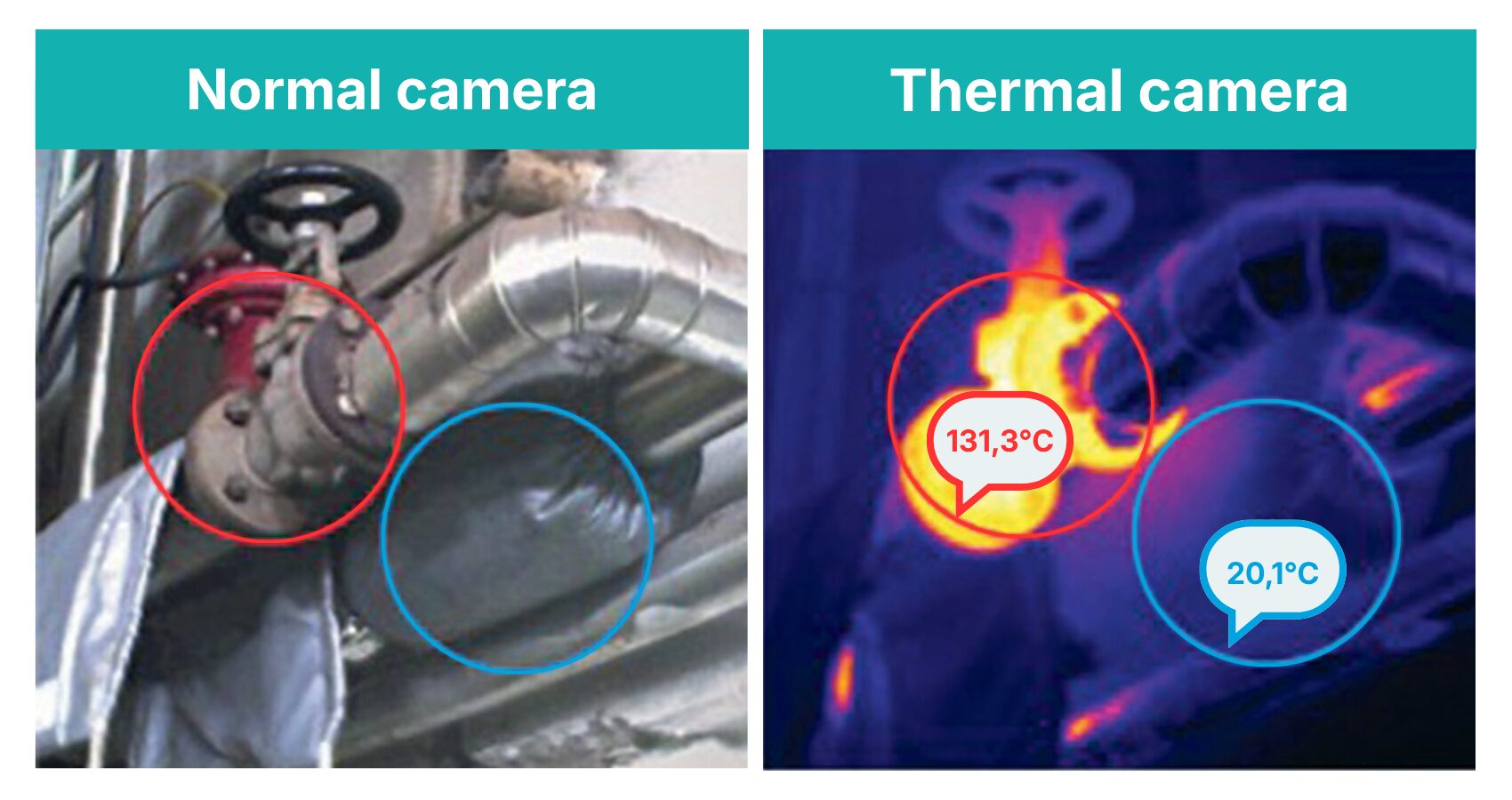
- The uninsulated valve marked with a red circle continuously radiates heat at a surface temperature of 131.3 °C into the surrounding environment. This increases room temperature, raises ventilation and cooling demand, and creates a serious burn hazard for workers.
- The insulated valve marked with a blue circle has cooled down to approximately 20 °C, making it significantly safer for personnel.
This is a typical example of how large the difference can be between insulated and uninsulated components in industrial systems.
How much does an uninsulated valve cost?
The larger the valve and the higher the system temperature, the greater the energy loss. Measurements carried out by FILTER have shown at least twofold differences between insulated and uninsulated components.
Energy loss at 160 °C

Energy loss at 100 °C

If a factory has dozens or even hundreds of similar components, annual energy losses can quickly grow into tens of thousands of euros.
Example: 160 °C DN100 Globe Valve
- 1 valve → ~470 € per year
- 10 valves→ ~4 700 € per year
- 50 valves → ~23 500 € per year
- 75 valves → ~35 250 € per year
- 100 valves → ~47 000 € per year
Example: 160 °C DN200 Globe Valve
- 1 valve → ~1260 € per year
- 10 valves→ ~12 600 € per year
- 50 valves → ~63 000 € per year
- 75 valves → ~94 500 € per year
- 100 valves → ~126 000 € per year
Uninsulated components reduce workplace safety
Uninsulated piping and fittings are not only an energy issue. Hot surfaces increase burn risks, higher ambient temperatures reduce worker productivity, and the likelihood of workplace accidents increases.
Additional risks include:
- noisy piping systems disturbing the work environment
- sharp edges causing injuries
- icing during winter conditions
- extremely hot and dangerous surfaces during summer
All surfaces above 40 °C should be insulated to improve both workplace safety and energy efficiency.
How do insulation covers reduce energy costs?
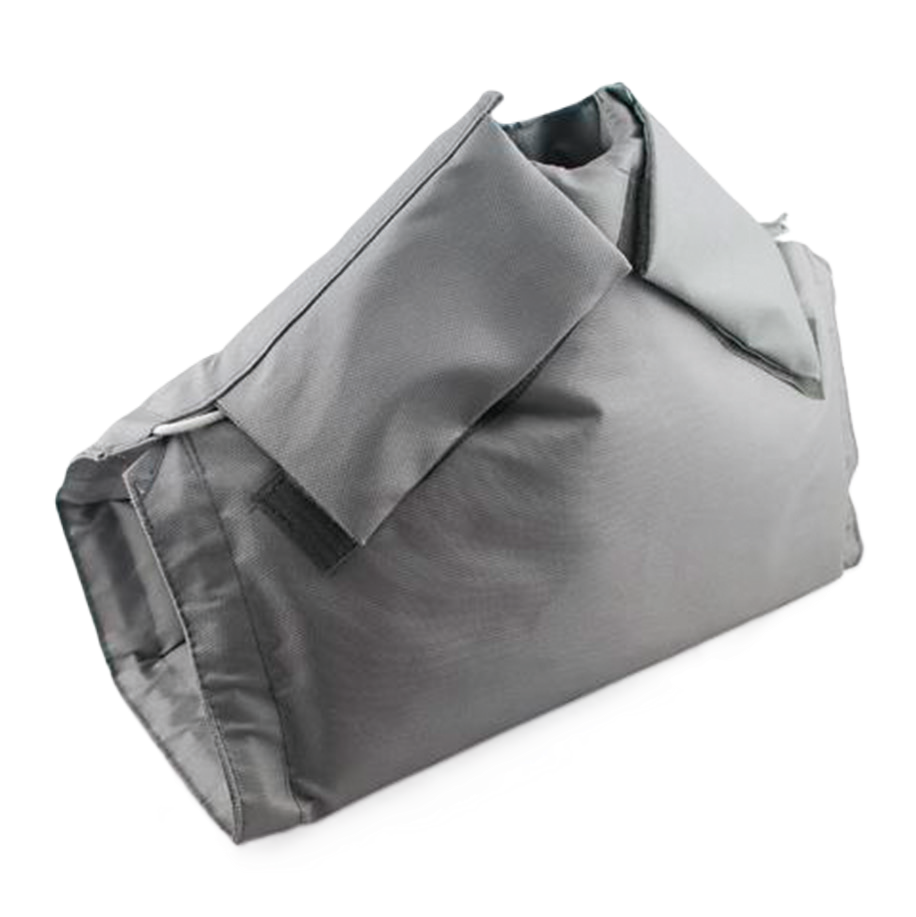
The simplest way to reduce heat loss is to use removable insulation covers on valves, steam traps, and other hot components.
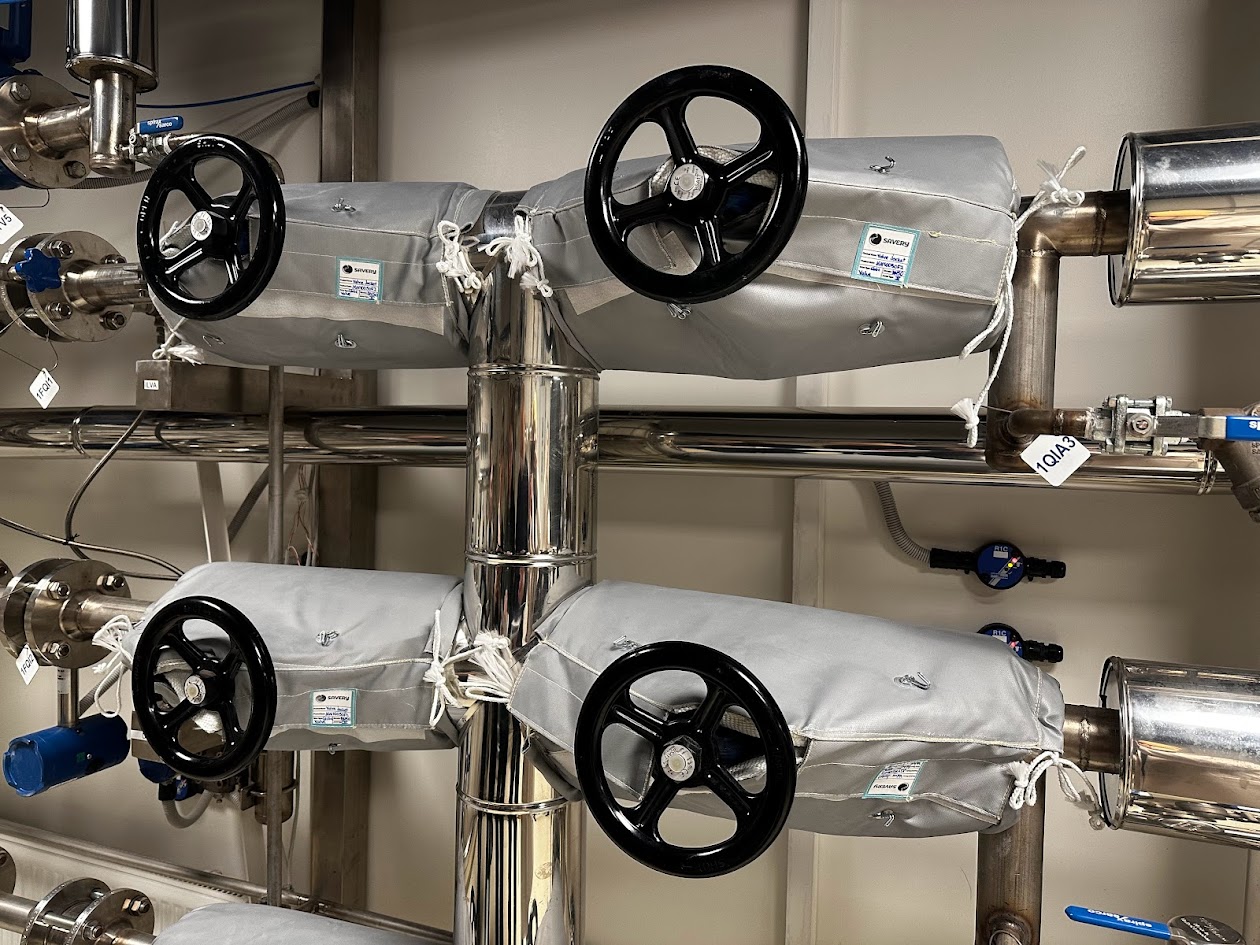
Savery insulation jackets are suitable even for tight and humid environments, helping improve both system efficiency and workplace safety.
Benefits of Savery insulation jackets
- Reduce heat loss by up to 90%
- Easy to install and remove
- Improve workplace safety
- Suitable for valves, steam traps, and strainers
- Available in sizes from DN15 to DN300
Typical payback period of less than 1 year
The payback period for these solutions is usually less than one year, making industrial insulation one of the fastest ways to reduce energy costs.
Learn more about Savery insulation covers
Start where the impact is greatest
Industrial energy loss does not only occur in large equipment. In many cases, the biggest savings are hidden in uninsulated valves, steam traps, and other hot components.
Would you like to know how much energy your factory is losing?
Contact us and we will help you assess:
- where the largest energy losses occur
- which components require insulation
- how quickly the investment will pay back
Frequently Asked Questions
How much energy is lost through an uninsulated valve?
Depending on temperature and size, a single uninsulated valve can cause energy losses worth hundreds or even thousands of euros per year.
How quickly does valve insulation pay back?
In most cases, within less than one year, especially in high-temperature systems.
Do insulation covers improve workplace safety?
Yes. They reduce surface temperatures and help prevent burn injuries.
Which components can be insulated?
Valves, steam traps, strainers, and other hot industrial components can all be insulated.